
Summary
- Monad has strong fundamentals, including a 0.4 second block time, 100% EVM compliance, and 0.8-second finality.
- Bullish estimates suggest its price could go towards $15.
- Base case suggests it could get above $0.25, i.e., the launch price.
- Bear case suggests it could crash below $0.1.
Table of Contents
Monad Fundamentals
Monad is an EVM-compatible blockchain that offers features such as smart contracts, DeFi, dApps, transactions, 0.8-second finality, and 0.4-second block times.
The blockchain was designed to operate more efficiently than Ethereum, without being dependent on it like a Layer-2 blockchain. As a result, Monad was created as an independent blockchain capable of working with the same DeFi, dApps, Solidity smart contracts, and other technologies that Ethereum supports.
Why Choose Monad over Ethereum?
Monad offers sub-second finality and block times, whereas Ethereum’s block time is 12 seconds (proposed to reduce to 8). Lower block time allows fast transactions and low competition for users, which results in predictable gas prices.
Since it is EVM-compliant, it is suitable for more resource-intensive applications like bot trading, blockchain gaming, and other mass-market applications. Dapps combating high transaction prices and slower transactions can simply opt for Monad.
The only reason why it beats BNB chain (the strongest Ethereum alternative) is that BNB has all captive validators (21 in total), whereas Monad is much more decentralized with 99 validators. Lack of decentralization results in exploits such as the one in the Ronin Blockchain Bridge in June 2022. Ronin had 7 validators, and 4 were captured by Lazarus Group hackers, resulting in a $625 million loss.
Why 2030 Matters?
I have created this article with a view to how its price would perform in 2030 because of the following reasons:
- The year 2030 will act as a critical litmus test for the principles of decentralization and blockchain technology.
- Traditional Fintech is expected to be dominated by blockchain technology by that year.
- The year is also a critical one in terms of quantum computing, as they might be able to decode blockchain wallet keys by that time.
Historical Performance
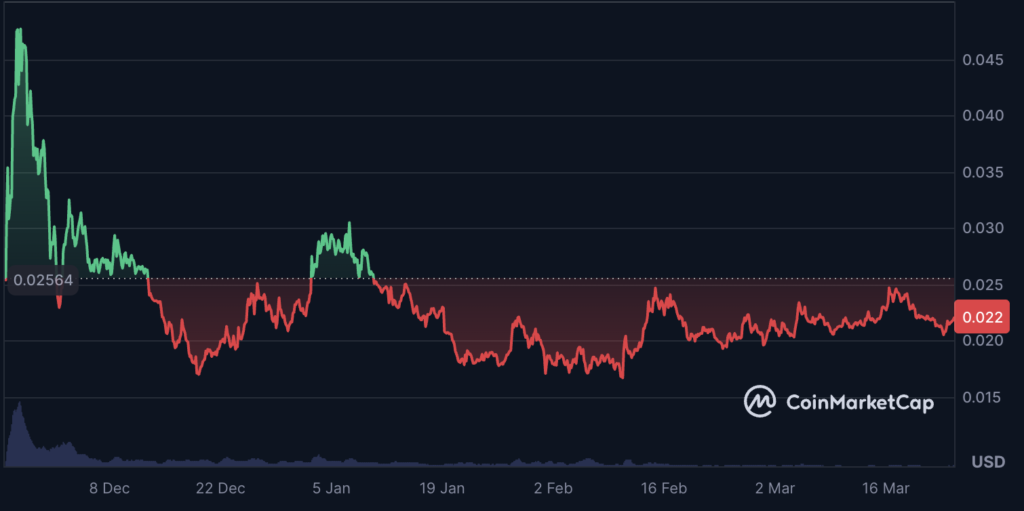
The MON token was launched on 24 November 2025 and is a relatively new cryptocurrency. Upon launch at 2 cents ($0.02), its price first soared to $0.047 and then crashed to $0.017 within a month.
The price has since then been trading between $0.25 and $0.17.
You can track the live Monad token (MON) price in the widget below.
MON Price Prediction Models
Fundamental Analysis Model
Scores are normalized against the top 50 coins, so early-stage gaps are penalized.
Quantitative Metrics
- Active Addresses: 3.5 (limited mainnet usage; testnet-heavy)
- Transaction Volume: 3.0 (no sustained economic throughput yet)
- Transaction Count: 5.5 (elevated on testnet; not value-backed)
- New Address Growth: 6.5 (strong testnet onboarding)
- Whale Accumulation: 6.5 (VC-heavy positioning; strategic capital)
- Holder Distribution: 5.0 (early, moderately concentrated)
- Long-Term Holder Supply: 5.5 (not fully observable pre-launch)
- Exchange Netflow: 1.0 (no meaningful CEX flow pre-TGE)
- Exchange Reserves: 1.0 (not applicable pre-listing)
- Stablecoin Inflows: 2.5 (indirect via ecosystem funding)
- Open Interest: 1.0 (no derivatives market yet)
- Funding Rate: 1.0 (not applicable)
- Liquidations: 1.0 (not applicable)
- MVRV: 1.0 (no realized market structure yet)
- NUPL: 1.0 (not applicable)
Qualitative Metrics
- X (Twitter) Activity: 8.5 (high narrative traction among CT)
- Reddit Activity: 5.5 (limited retail penetration so far)
- Telegram/Discord Activity: 8.0 (active early community)
- NLP Sentiment Score: 8.5 (strong positive bias)
- Influencer Sentiment Bias: 8.5 (backed by prominent VCs/founders)
- News Sentiment: 8.0 (favorable coverage as “next-gen L1”)
- GitHub Activity: 8.5 (high engineering intensity)
- Ecosystem Growth: 7.5 (early builder interest forming)
- Partnerships: 7.0 (infrastructure + early integrations)
- Brand Strength: 7.5 (recognized within crypto-native circles)
- Narrative Fit: 9.0 (high-performance / parallel execution theme)
- Retail Mindshare: 5.5 (not yet mainstream)
Composite Score
Monad has a composite fundamental score of 5.6/10, indicating a high-potential but early-stage asset with strong narrative and developer momentum, offset by the lack of mature on-chain and market-structure data.
Institutional and Analyst Consensus
- Coinbase conservative model (5% annual growth assumption): $0.03 by 2030.
- CoinCodex algorithmic/machine-learning model: $0.060 (approx. +171% from current levels).
- DigitalCoinPrice analysts: $0.033 – $0.065 (average around $0.052–$0.062 in various updates).
- LBank forecast: $0.0286 by 2030.
- BeInCrypto / moderate technical models: Average around $0.022 – $0.030 (with max near $0.030 in base scenarios).
- Bitget analyst scenarios:
- Bearish: $0.10 – $0.15
- Neutral: $0.20 – $0.30
- Bullish: $0.40 – $0.50
- BTCC analysts (compared to other L1 launches):
- Conservative: $0.10 – $0.25
- Baseline: $0.40 – $0.90
- Bullish: $1.00 – $2.50
- CryptoNinjas / adoption-focused view: $0.20 – $0.30 (assuming moderate success in validator stability and transaction demand).
- Stealthex / PricePrediction aggregation: $0.075 (average), with range $0.0245 – $0.1308.
- CoinDataFlow simulation model: Up to $0.096 – $0.108 in optimistic scenarios (minimum around $0.024).
- Traders Union statistical model: Around $0.015 – $0.019 (bearish/low-growth outlook).
- MEXC / high-upside scenario models (early aggressive forecasts): $15 – $100+ in extreme bullish cases (highly speculative and outlier views).
- Other moderate/aggregated views (e.g., OpenExo, Phemex adoption scenarios): $0.20 – $0.30 base case.
Technical Models
After falling in a descending channel just after launch, Monad saw a false breakout around mid-January 2026 and has since then remained range-bound between $0.15 (bottom) and $0.25 (upside). Any trading opportunity arrives only when it breaks above $0.25.
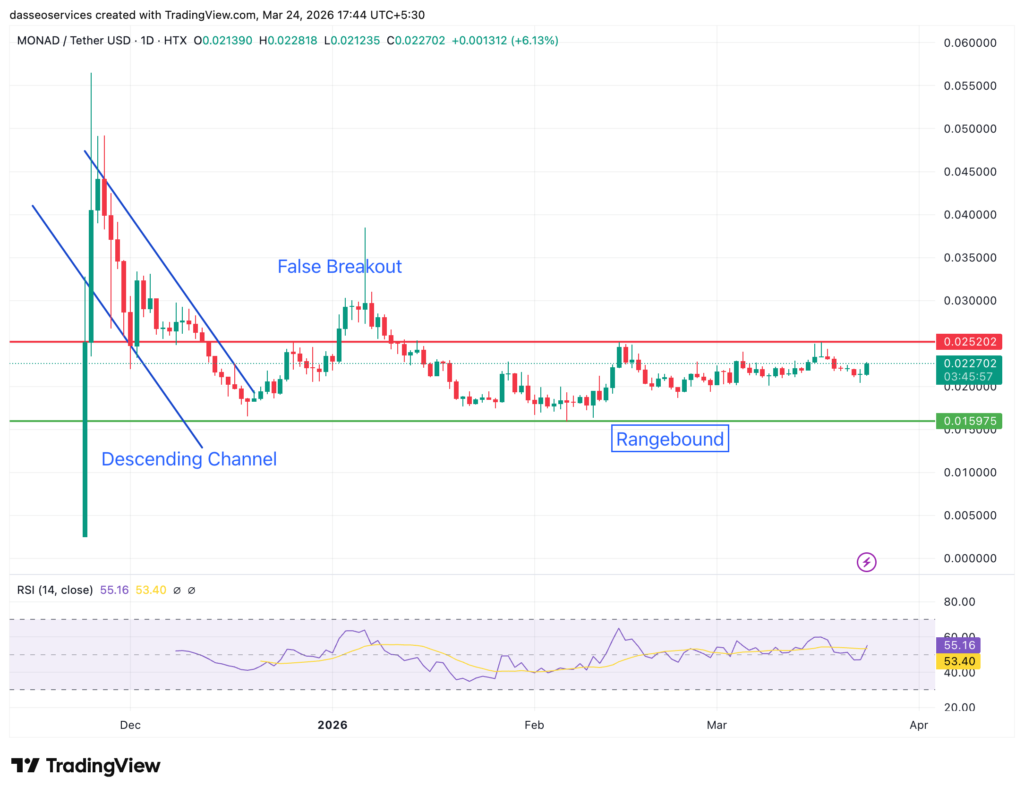
Technical models combined with event data indicate that it might breakout above $0.25 in the near future if Bitcoin breaks above $80k and pulls the entire crypto market with it. We expect this to happen around the end of March 2026. In the worst possible scenario, this could extend to June 2026, when we expect a 1% rate cut.
Scenario-Based Forecast
The best-case scenario could be:
- Monad rises to a top 20 Layer-1 coins.
- It consistently gains users through all its marketing activities.
- Monad Mainnet reliably reaches 10,000 transactions per second.
- A high level of migration or adoption takes place.
- Monad captures tokenized asset markets.
- MON token sees high demand for gas and staking.
Extreme Bull Case
In the extreme bull case where all the above things happen, Monad could see a high price of $15.
Bull Case
In the bull case, where Monad achieves most of these things, we could see a price surge to $1.
Base Case
In the base case, Monad is at least expected to recover above its launch price of $0.25.
Bear Case
The bear case could see Monad crashing down to $0.15, its next support zone.
Extreme Bear Case
In the extreme bear case, Monad could crash below $0.05.
Key Drivers to Watch
General Recovery in Crypto Markets
A general recovery in broader markets would provide some breathing room for smaller altcoins like Monad, which are typically bought alongside other coins.
In my experience working with funds, they create categories of cryptocurrencies to acquire when the time is right. These cryptocurrencies are then bought together.
Otherwise, the individual traction on these platforms is very low. For instance, the Monad subreddit had only 7,000 subscribers 5 months after launch.
Need for BNB’s Alternative
BNB has long served as an alternative to Etheruem, offering low-cost custody and transactions for Ethereum, DeFi, and dApps.
Every other Ethereum alternative is either Ethereum-dependent, such as L2s, or based on the EVM blockchain.
As a result, there was a need for an EVM-compliant blockchain outside the Ethereum ecosystem.
Ethereum’s Delay in Upgrades
Ethereum has never planned for sub-second finality. The current plan is to reduce block time to 8 seconds from 12 seconds. Whereas, Monad already has a 0.8s finality and a 0.4s block time.
Cross Chain Compatiblity Developments
Users and investors of Monad also need to ensure they keep an eye on the cross-chain protocols because of other major chains like Solana can get linked to Ethereum, with the ability to transfer assets, it could change the entire future of Monad, which will obviously become useless because it won’t be able to compete with Solana.
Risks
Business Risks
There are certain risks, such as getting out of the competition and being dominated by other L1 chains, that stakeholders need to keep an eye on. Because Monad is a new blockchain, it is entirely possible that it gets dominated by others.
Protocol Level Risks
New blockchains tend to skip due diligence on a scale required to prevent all side attacks. These lacks have sunk a stablecoin called Resolv USR, where a hacker minted $80 million worth of fake coins and was able to take out $25 million before the protocol was locked by the team. As a result, the stablecoin sank 80% within 24 hours of the hack.
Frequently Asked Questions
Is Monad quantum resistant?
No, Monad is not quantum resistant blockchain because it is 100% EVM compatible, meaning it mirrors EVM in its development. Since the Ethereum Virtual Machine (EVM) itself is not quantum-resistant, Monad lacks it too.
